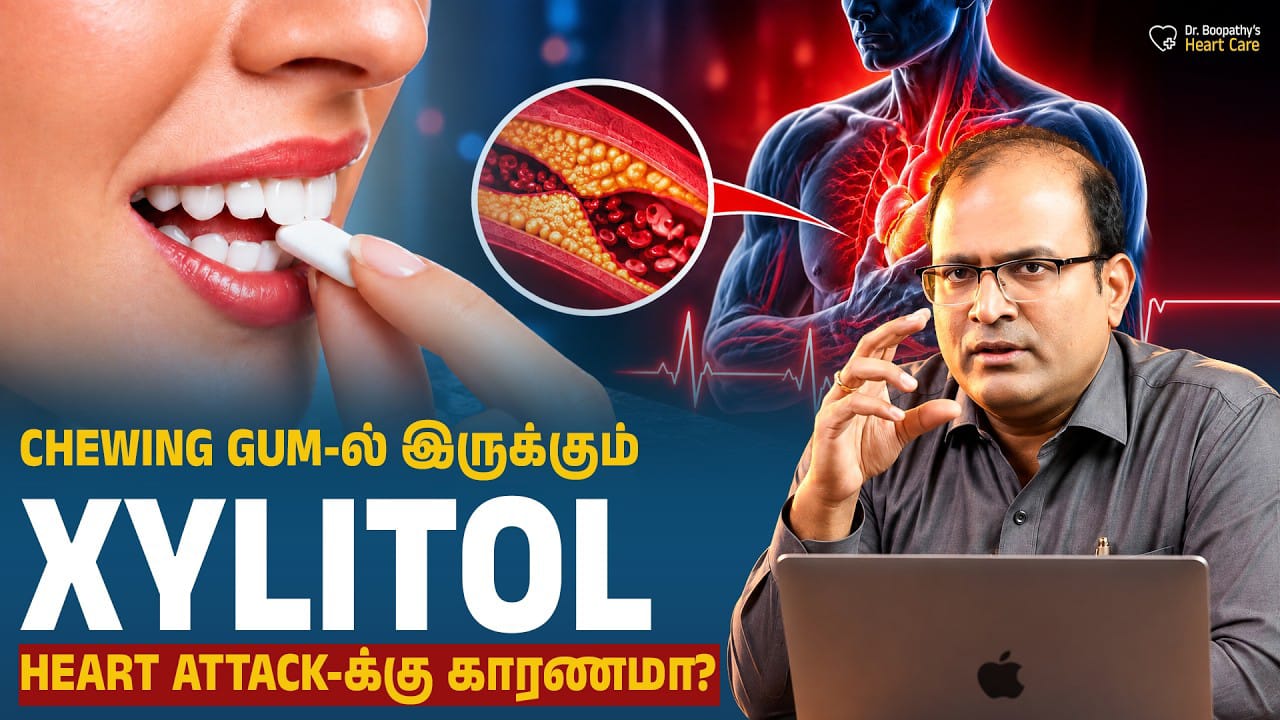
“Sugar-free” sounds healthy.
That is why many people automatically assume that a sugar-free chewing gum, candy, drink or snack must be a better choice for their health.
One sweetener commonly used in these products is xylitol.
For years, xylitol has been especially popular in sugar-free chewing gum because it provides sweetness without ordinary table sugar and does not promote dental cavities in the same way as sucrose.
But recent cardiovascular research has raised an important question:
Could high exposure to xylitol have effects on the heart and blood vessels that we do not yet fully understand?
The answer at present is not:
“Xylitol causes heart attacks.”
The science is more nuanced.
Recent studies have found that people with higher levels of xylitol in their blood had a higher rate of cardiovascular events such as heart attack, stroke and death.
Researchers have also observed that xylitol may influence platelet activity, which is important because platelets are involved in blood-clot formation.
However, these findings do not yet prove that eating a piece of sugar-free chewing gum directly causes a heart attack.
In this article, Dr. S. Nagendra Boopathy, Professor of Cardiology and Senior Consultant Interventional Cardiologist in Chennai, explains what xylitol is, why the recent research has attracted attention, what the results actually mean and how consumers can make sensible decisions without unnecessary fear.
What Exactly Is Xylitol?
Xylitol belongs to a group of substances known as sugar alcohols, or polyols.
Despite the name, it is not the same as alcoholic beverages.
Xylitol tastes sweet but differs chemically and metabolically from regular table sugar.
Small amounts of xylitol can occur naturally, and the human body can also produce small quantities during normal metabolism.
Commercially manufactured xylitol is used as a sweetener in many products.
Where Is Xylitol Commonly Found?
You may find xylitol in products labelled:
- Sugar-free
- No added sugar
- Low sugar
- Dental-friendly
Common examples can include:
- Sugar-free chewing gum
- Sugar-free mints
- Certain candies
- Some baked products
- Some low-sugar foods
- Certain oral-care products
- Some nutritional products
Not every sugar-free product contains xylitol.
Always check the ingredient list.
Is Xylitol the Same as an Artificial Sweetener?
Not exactly.
The term “artificial sweetener” is often used loosely for almost every sugar substitute, but different sweeteners belong to very different chemical groups.
For example, common sugar substitutes include:
- Aspartame
- Sucralose
- Saccharin
- Acesulfame potassium
- Xylitol
- Erythritol
Xylitol and erythritol are sugar alcohols, whereas substances such as aspartame and sucralose belong to other categories of low- or no-calorie sweeteners.
They should not automatically be assumed to have identical effects on the body.
Why Has Xylitol Recently Been Discussed in Heart Health?
Recent research has examined whether higher circulating levels of xylitol are associated with cardiovascular events.
Researchers studied large groups of people and compared those with relatively low blood xylitol levels with people who had much higher levels.
They found that the people with higher circulating xylitol tended to experience more major cardiovascular events.
These included:
- Heart attack
- Stroke
- Cardiovascular-related events
- Death included within the study’s combined cardiovascular outcome
That finding has understandably generated considerable attention.
But it must be interpreted correctly.
Does the Study Prove That Xylitol Causes Heart Attacks?
No.
This is probably the most important point in the entire discussion.
The large population analysis was observational.
Observational studies can identify an association.
They can tell us:
“People with higher blood xylitol levels experienced more cardiovascular events.”
But they cannot automatically prove:
“The xylitol caused those cardiovascular events.”
There may be additional factors involved.
Association Is Not the Same as Causation
Imagine that people carrying umbrellas are more likely to be seen when the roads are wet.
You could find a strong association between:
Umbrellas
and
Wet roads.
But umbrellas do not cause rain.
The same principle applies to observational health research.
Researchers must ask:
- Is the substance itself responsible?
- Is another metabolic condition causing both?
- Are people with certain illnesses more likely to have higher blood levels?
- Are dietary habits contributing?
- Are there unmeasured factors?
That is why stronger evidence usually requires multiple types of studies.
Why Is the Xylitol Finding Still Important?
Although observational evidence does not prove causation, the story becomes more interesting because laboratory studies have also suggested a possible biological mechanism.
Researchers have investigated whether xylitol could affect platelets.
Platelets are tiny components of blood that help stop bleeding.
When you cut yourself, platelets become activated and help form a clot.
That is essential for survival.
But excessive platelet activation inside an artery can become dangerous.
What Do Platelets Have to Do With Heart Attacks?
Many heart attacks occur when a cholesterol-rich plaque inside a coronary artery becomes unstable and ruptures.
The body interprets that rupture almost like an injury.
Platelets rush to the area.
They begin sticking together.
A blood clot forms.
If that clot completely blocks the coronary artery, blood can no longer reach part of the heart muscle.
That results in a heart attack.
A similar clotting process can contribute to certain strokes.
Could Xylitol Make Platelets More Reactive?
Laboratory and small human experimental studies have suggested that xylitol exposure may increase certain measures of platelet responsiveness.
This provides a possible biological explanation for why researchers are interested in the relationship between xylitol and cardiovascular events.
However:
A biological mechanism plus an observational association still does not prove that normal dietary xylitol intake causes heart attacks.
More research is necessary.
Higher Blood Xylitol Does Not Necessarily Mean Someone Ate More Xylitol
This is another important nuance.
The body naturally produces some xylitol as part of metabolism.
Therefore, measuring xylitol in the bloodstream is not necessarily identical to measuring exactly how much xylitol someone consumed.
Researchers need to understand:
- How much comes from food
- How much is produced internally
- Whether metabolic disease influences the level
- How long dietary xylitol raises blood levels
This is one reason the results should not be oversimplified.
Should We Be Worried About Sugar-Free Chewing Gum?
There is no reason to panic because you occasionally chew sugar-free gum.
The available research does not establish that one piece of xylitol gum causes a heart attack.
The more reasonable question is:
Should we consume large quantities of highly sweetened processed products every day simply because they are labelled “sugar-free”?
Probably not.
“Sugar-free” should not automatically be interpreted as:
- Unlimited
- Completely harmless
- Heart-protective
- Healthy in every quantity
Moderation still matters.
Does “Sugar-Free” Mean Healthy?
No.
A sugar-free label tells you mainly that the product contains little or no conventional sugar according to its formulation.
It does not tell you everything about the food.
A sugar-free product may still contain:
- Sweeteners
- Refined carbohydrates
- Saturated fat
- Sodium
- Additives
- Significant calories
The entire food matters.
Should People With Diabetes Replace All Sugar With Sweeteners?
Not necessarily.
People with diabetes understandably try to reduce added sugar.
That is important.
But the goal should not simply be:
Sugar → unlimited sweeteners.
A better long-term strategy is often to gradually reduce the overall preference for intensely sweet foods.
For example:
Instead of making tea equally sweet with a substitute, you may gradually learn to enjoy tea with much less sweetness.
This can reduce dependence on both sugar and sugar substitutes.
Do Not Switch Back to Large Amounts of Sugar Because of This Research
This is equally important.
Hearing concerns about xylitol should not lead someone to say:
“Then normal sugar must be safer. I will go back to adding lots of sugar.”
That would be the wrong conclusion.
Excessive added sugar can contribute to:
- Weight gain
- Diabetes
- High triglycerides
- Fatty liver
- Metabolic disease
- Cardiovascular risk
The goal is not to choose between large amounts of sugar and large amounts of sugar substitutes.
The better goal is:
Reduce the need for excessive sweetness altogether.
Is Natural Sugar Better?
The context matters.
Sugar naturally present inside a whole fruit comes packaged with:
- Fibre
- Water
- Vitamins
- Minerals
- Plant compounds
That is very different from consuming large quantities of added sugar in:
- Soft drinks
- Desserts
- Sweets
- Packaged foods
Whole fruits should therefore not be placed in the same category as concentrated added sugar.
What About People Who Already Have Heart Disease?
Patients with established cardiovascular disease should be especially thoughtful about their overall diet.
This includes people who have had:
- Heart attack
- Angioplasty
- Coronary stent
- Bypass surgery
- Stroke
- Significant coronary artery disease
There is currently not enough evidence to tell every cardiac patient that all xylitol exposure must be eliminated.
But routinely consuming large amounts of processed sugar-free foods purely because they are marketed as “healthy” is unnecessary.
Focus instead on an overall cardioprotective dietary pattern.
What Should a Heart-Healthy Diet Focus On?
Choose more:
- Vegetables
- Whole fruits
- Pulses
- Legumes
- Whole grains
- Nuts
- Seeds
- Appropriate protein
- Minimally processed foods
Reduce excessive:
- Added sugar
- Sugary drinks
- Refined foods
- Highly processed foods
- Excess sodium
- Trans fats
- Excess saturated fat
One ingredient rarely determines cardiovascular health by itself.
Your overall dietary pattern matters far more.
Does Xylitol Help Prevent Dental Cavities?
Xylitol-containing products have been used in oral health partly because oral bacteria do not metabolise xylitol in the same way they metabolise ordinary sugars.
This does not mean that cardiovascular concerns should be ignored.
But it also means the discussion should remain balanced.
A substance can have useful properties in one context while researchers continue investigating its effects in another.
Should Children Avoid All Xylitol?
Current cardiovascular research does not justify declaring that every xylitol-containing product is unsafe for every child.
However, children should not be encouraged to consume large amounts of sweetened processed products—whether those products contain:
- Sugar
- Xylitol
- Other sweeteners
Developing a preference for less-sweet foods from childhood is generally a sensible habit.
Can Too Much Xylitol Cause Digestive Problems?
Yes.
Sugar alcohols are incompletely absorbed in the digestive tract.
Large amounts can cause:
- Bloating
- Gas
- Abdominal discomfort
- Loose stools
- Diarrhoea
Tolerance differs between individuals.
This is another reason that “sugar-free” should not mean “consume without limit.”
Is Xylitol Safe for Dogs?
This is unrelated to cardiovascular disease but extremely important for households with pets.
Xylitol can be highly toxic to dogs.
Even relatively small amounts can produce severe hypoglycaemia and other serious complications.
Keep xylitol-containing chewing gum, candies and other products completely out of a dog’s reach.
Should You Read Food Labels?
Yes.
If you regularly consume sugar-free products, look at the ingredient list.
Possible sweeteners may include:
- Xylitol
- Erythritol
- Sorbitol
- Maltitol
- Sucralose
- Aspartame
- Saccharin
Do not assume all sugar substitutes are identical.
How Much Xylitol Is Safe?
At present, cardiovascular science does not provide a precise universal daily xylitol limit specifically for preventing heart attack or stroke.
Therefore, it would be misleading to give everyone one number.
A practical approach is:
Avoid unnecessarily high and frequent intake.
Especially avoid treating sugar-free sweets, gum or drinks as foods that can be consumed without limits.
What Should You Do If You Chew Xylitol Gum Every Day?
There is no need to panic.
You can:
- Check how much you actually consume
- Reduce excessive use
- Avoid repeatedly consuming multiple xylitol products throughout the day
- Discuss concerns with your doctor if you already have significant cardiovascular disease
Do not abruptly change important diabetes or cardiac treatment based on a headline.
Should You Stop Xylitol Completely?
Current evidence does not support a blanket statement that every person must eliminate every source of xylitol.
The more scientifically responsible message is:
Be cautious about high intake while research continues.
An occasional product is very different from frequent high-dose consumption.
Is Xylitol Worse Than Sugar?
That question cannot be answered with a simple yes or no.
Excessive conventional sugar has well-established metabolic harms.
Xylitol may reduce some of those problems because it does not behave metabolically exactly like sugar.
But emerging evidence has raised separate questions about cardiovascular effects.
Therefore:
The healthiest strategy is not excessive consumption of either.
What About Other Sugar Substitutes?
Evidence differs between individual sweeteners.
We should not automatically assume findings involving xylitol apply equally to:
- Aspartame
- Sucralose
- Saccharin
- Stevia
- Erythritol
Each needs to be evaluated separately.
Why Nutrition Headlines Can Be Misleading
You may see headlines such as:
“Sugar-free gum causes heart attacks.”
That overstates the evidence.
You may also see:
“The study proves nothing, so xylitol is completely safe.”
That also goes too far.
A better interpretation is:
New evidence has raised a credible cardiovascular safety question that deserves further investigation.
That is how medical science normally progresses.
What Kind of Research Is Needed Next?
Researchers need additional studies to answer questions such as:
- Does long-term dietary xylitol intake itself increase cardiovascular events?
- Is there a dose-response relationship?
- Which patients may be particularly vulnerable?
- How much of circulating xylitol comes from diet versus internal metabolism?
- Does reducing xylitol intake reduce cardiovascular risk?
Randomised and carefully controlled studies can help answer some of these questions.
Should Cardiac Patients Be More Cautious?
It is reasonable for patients with established cardiovascular disease to avoid unnecessarily high consumption of processed sweetened products.
But cardiac prevention should focus first on the major proven risk factors:
- LDL cholesterol
- Blood pressure
- Diabetes
- Smoking
- Weight
- Exercise
- Medication adherence
Do not become so focused on one sweetener that these much larger risk factors are neglected.
Frequently Asked Questions About Xylitol and Heart Health
1. What is xylitol?
Xylitol is a sugar alcohol used as a sweetener in many sugar-free products.
2. Where is xylitol found?
It may be found in:
- Sugar-free chewing gum
- Mints
- Candies
- Certain foods
- Some oral-care products
Check the ingredient label.
3. Is xylitol the same as sugar?
No.
It tastes sweet but has a different chemical structure and metabolism from ordinary table sugar.
4. Is xylitol completely artificial?
No.
Small amounts occur naturally and can also be produced by the human body.
Commercial xylitol is manufactured for use as a sweetener.
5. Does xylitol raise blood sugar like normal sugar?
It generally has a much smaller effect on blood glucose than ordinary sugar.
However, that does not automatically mean every xylitol-containing food is healthy.
6. Does xylitol cause heart attacks?
Current research does not prove that dietary xylitol directly causes heart attacks.
Higher circulating xylitol has been associated with cardiovascular events, and further research is needed.
7. What cardiovascular problems have researchers studied?
Studies have examined major cardiovascular events including:
- Heart attack
- Stroke
- Death as part of combined cardiovascular outcomes
8. What does “higher risk” mean in these studies?
It means the group with higher measured blood xylitol experienced more cardiovascular events than the group with lower levels.
It does not mean everyone consuming xylitol will develop heart disease.
9. Was this a randomised trial?
The large long-term population analysis was observational.
Therefore, it identifies an association but cannot by itself establish causation.
10. Why are doctors still paying attention to the finding?
Because separate mechanistic research has suggested that xylitol may influence platelet activation and blood-clot formation.
This makes the association scientifically important enough to investigate further.
11. What are platelets?
Platelets are small blood components that help form clots and stop bleeding after injury.
12. Why can platelet activation be dangerous?
If excessive clotting occurs inside an artery, it can contribute to:
- Heart attack
- Certain strokes
13. Should I stop chewing sugar-free gum?
Not necessarily.
There is no reason to panic over occasional use.
However, avoiding excessive daily intake is reasonable.
14. I have been chewing xylitol gum for years. Should I get a heart test?
Not solely because you have consumed xylitol.
Heart testing should be based on your overall cardiovascular risk, symptoms and medical history.
15. Should someone with a previous heart attack avoid xylitol?
There is not yet enough evidence to make a universal prohibition.
But avoiding excessive intake of processed sugar-free products is a sensible precaution.
16. Should diabetics stop using xylitol?
Do not make sudden dietary or medication changes based on one study.
People with diabetes should focus on reducing excessive sweetness overall and discuss major diet changes with their clinician or dietitian.
17. Is regular sugar safer than xylitol?
You cannot conclude that from the research.
Excess added sugar has well-established metabolic risks.
18. Should I switch back from sugar-free drinks to sugary drinks?
No.
A better strategy is to reduce sweetened beverages overall.
Water, unsweetened beverages and less-sweet dietary patterns are preferable.
19. Is stevia safer?
Different sweeteners have different evidence.
Current xylitol findings should not automatically be transferred to every other sweetener.
20. Is erythritol the same as xylitol?
No.
Both are sugar alcohols, but they are different substances.
Each needs separate scientific evaluation.
21. Does the body naturally make xylitol?
Yes.
Small amounts can arise from normal metabolic pathways.
22. Does this affect interpretation of blood tests?
Yes.
Higher blood xylitol does not necessarily reflect dietary xylitol intake alone.
That is an important limitation when interpreting observational research.
23. Is “sugar-free” always healthier?
No.
Always consider the whole product.
A sugar-free snack can still be highly processed or calorie-dense.
24. Can xylitol cause stomach problems?
Yes.
High intake can cause:
- Gas
- Bloating
- Loose stools
- Diarrhoea
25. Is xylitol dangerous for dogs?
Yes.
Xylitol can be extremely toxic to dogs and should be kept away from pets.
26. Is one piece of xylitol gum dangerous?
Current evidence does not support such a conclusion.
The concern is about understanding the potential effects of higher exposure and circulating levels.
27. How much xylitol is too much for the heart?
There is currently no established cardiovascular threshold that applies to everyone.
28. Should children consume sugar-free products every day?
Children should not depend heavily on processed sweetened products, whether the sweetness comes from sugar or substitutes.
Developing a lower preference for sweetness is preferable.
29. What should heart patients focus on more than xylitol?
The strongest priorities remain:
- Stop smoking
- Control LDL cholesterol
- Control blood pressure
- Control diabetes
- Exercise
- Maintain a healthy weight
- Take prescribed medication consistently
30. What is the main message from the new xylitol research?
Do not panic—but do not assume “sugar-free” means unlimited or completely risk-free.
Emerging research has raised a cardiovascular safety question about high circulating xylitol.
It deserves further investigation.
Until we know more, moderation is a sensible approach.
A Simple Approach to Sweeteners
Instead of asking:
“Which sweetener can I consume without any limit?”
Ask:
“Can I gradually reduce how sweet I need my food and drinks to taste?”
For example:
If you currently take two teaspoons of sugar in tea, gradually move toward:
- One and a half
- One
- Half
- Eventually little or none
The same principle can reduce dependence on artificial or alternative sweeteners.
Final Takeaway
The recent discussion about xylitol should not create panic.
Xylitol is a sugar alcohol widely used in sugar-free products, particularly chewing gum and sweets.
Emerging research has found an association between higher circulating xylitol levels and cardiovascular events, and experimental research has raised questions about its effects on platelets and clot formation.
But:
Association is not proof of causation.
An occasional xylitol-containing product has not been proven to cause a heart attack.
Blood xylitol levels are not necessarily determined by diet alone.
More research is needed before definitive conclusions can be made.
In the meantime, there is one useful lesson:
“Sugar-free” should never mean “unlimited.”
Avoid excessive consumption of heavily processed sweetened foods.
Do not respond by going back to excessive ordinary sugar.
Instead, gradually train yourself to need less sweetness.
For cardiovascular health, your overall lifestyle remains far more important:
Eat mostly whole foods.
Exercise regularly.
Maintain a healthy weight.
Do not smoke.
Control diabetes, blood pressure and cholesterol.
One ingredient rarely determines your entire cardiovascular future.
Consult Dr. S. Nagendra Boopathy
Dr. S. Nagendra Boopathy
MBBS (MMC), MD (PGIMER), DM (Cardiology – AIIMS), FACC, FSCAI
Professor of Cardiology
Senior Consultant Interventional Cardiologist
Complex Coronary & Structural Heart Interventions
Dr. Boopathy Heart Care
6th Cross Street
Director’s Colony
Kodambakkam
Chennai – 600024
Appointment / Contact
+91 87544 98680
Sri Ramachandra Medical Centre
No. 1, Ramachandra Nagar
Porur
Chennai – 600116
Tamil Nadu
Hospital Enquiries
044-4592 8844 / 044-4592 8855
044-4001 2323
Emergency Services
044-4001 2345
Medical Disclaimer: This article is intended for general educational purposes only. Research into xylitol and cardiovascular disease is still evolving, and current observational evidence does not establish that dietary xylitol directly causes heart attacks or strokes. Do not stop prescribed medications or make major dietary changes based solely on this information. Consult your doctor for advice based on your individual cardiovascular and metabolic risk.