Long-distance air travel is usually safe. But sitting still for many hours can increase the risk of blood clots in some people—especially if there are additional risk factors such as recent surgery, leg injury, pregnancy, cancer, obesity, previous blood clots or an inherited tendency to clot.
One potentially serious complication is a pulmonary embolism, where a blood clot—usually formed in a deep vein of the leg—travels to the lungs and blocks blood flow.
The important point is that symptoms may not always begin during the flight.
A person may complete the journey, return home and only later develop:
- Sudden breathlessness
- Chest discomfort
- Rapid heartbeat
- Dizziness
- Unexplained weakness
- Leg swelling or pain
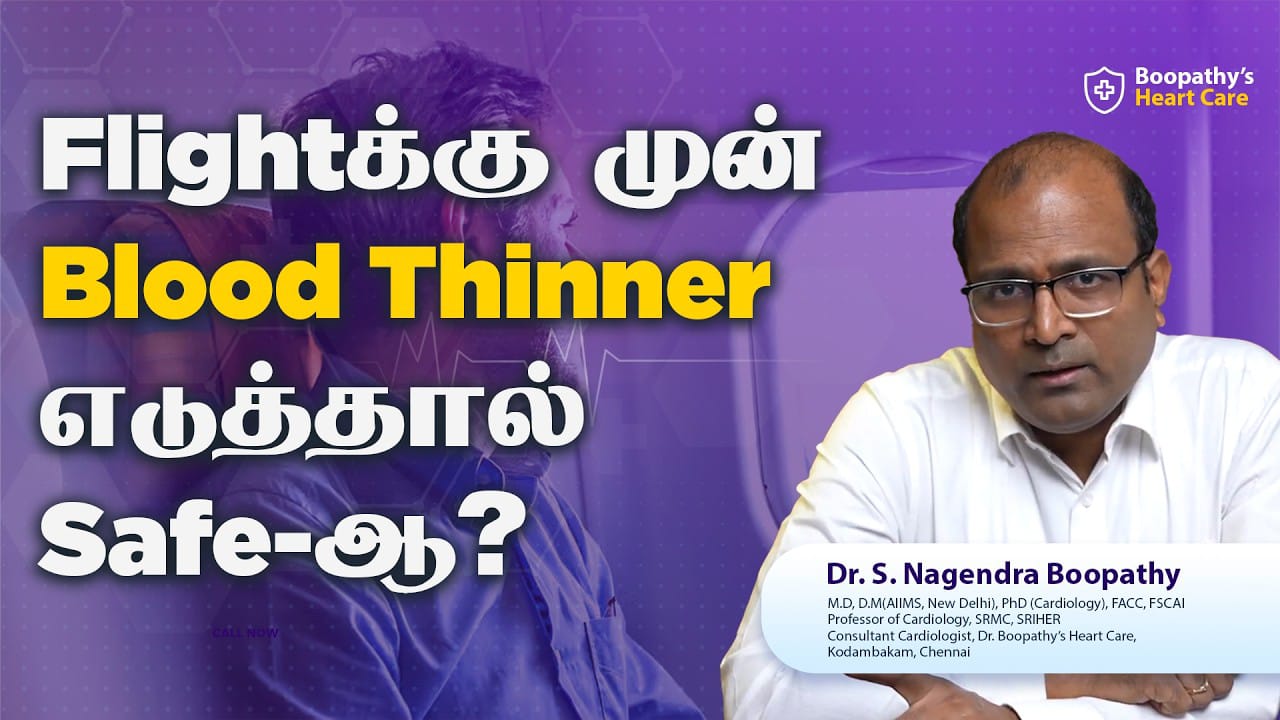
In this article, Dr. S. Nagendra Boopathy, Professor of Cardiology and Senior Consultant Interventional Cardiologist in Chennai, explains why long-haul travel can increase clot risk, who should be particularly careful, how to reduce the risk safely and when post-travel symptoms require urgent medical attention.
A Common Scenario
Imagine a 45-year-old businessman who recently had a minor fall.
There was no major fracture, but one leg became mildly swollen and he was walking with a slight limp.
A few days later, he had to take a long-haul international flight for an important business meeting.
The trip went well.
He returned home.
About a week later, however, he suddenly developed significant breathlessness during the night and had to be taken to hospital.
This type of situation raises an important possibility:
Could a blood clot have formed in the leg during or around the period of travel and then travelled to the lungs?
That is exactly why unexplained shortness of breath after long-distance travel should not automatically be dismissed as fatigue, jet lag or anxiety.
What Is a Deep Vein Thrombosis?
A deep vein thrombosis, or DVT, is a blood clot that forms in a deep vein, most commonly in the leg.
It can occur when blood flow becomes slow or when the body has an increased tendency to form clots.
A DVT may cause:
- Swelling in one leg
- Calf pain
- Warmth
- Tenderness
- Redness
However, some DVTs cause very few symptoms.
What Is a Pulmonary Embolism?
A pulmonary embolism, or PE, occurs when part of a blood clot breaks away and travels through the bloodstream.
It passes through the right side of the heart and enters the blood vessels of the lungs.
If the clot blocks a pulmonary artery, it can interfere with blood flow through the lungs.
Depending on the size of the clot and the patient’s underlying health, pulmonary embolism can range from mild to life-threatening.
Why Can Long Flights Increase Blood Clot Risk?
During a long flight, passengers may remain seated for several hours.
When the legs stay still for prolonged periods:
- Calf muscles contract less
- Blood returns more slowly toward the heart
- Blood can pool in the deep veins of the legs
The calf muscles are sometimes described as a kind of “peripheral pump” because every contraction helps push venous blood upward.
When these muscles are inactive for long periods, venous circulation slows.
This creates one of the conditions that can contribute to clot formation.
Virchow’s Triad: Why Blood Clots Form
Doctors often explain clot formation using Virchow’s triad, which includes three major factors:
1. Blood Stasis
This means slowed blood flow.
Long periods of sitting, immobility or bed rest can cause blood to remain relatively stagnant in the legs.
2. Blood Vessel Wall Injury
Damage or irritation to the inner lining of a blood vessel can promote clot formation.
This may occur with:
- Injury
- Surgery
- Inflammation
- Certain medical conditions
3. Increased Clotting Tendency
Some people have blood that clots more easily than normal.
This may occur because of:
- Inherited thrombophilia
- Cancer
- Pregnancy
- Certain hormone medications
- Other medical conditions
When more than one of these factors is present, the risk may increase further.
Who Is at Higher Risk During Long-Haul Travel?
Most healthy travellers will never develop a serious blood clot from flying.
However, risk may be higher in people with:
- Previous DVT
- Previous pulmonary embolism
- Recent major surgery
- Recent significant injury
- Limited mobility
- Leg cast or immobilisation
- Active cancer
- Cancer treatment
- Pregnancy
- Recent childbirth
- Obesity
- Certain inherited clotting disorders
- Use of estrogen-containing contraceptive pills
- Certain hormone therapies
- Advanced age
- Multiple medical risk factors
If several of these factors apply to you, it is sensible to discuss long-distance travel with your doctor beforehand.
Why a Recent Leg Injury Matters
Even a relatively minor leg injury can sometimes reduce mobility.
A person may:
- Walk less
- Avoid moving the ankle
- Sit for longer periods
- Develop swelling
Then, if they take a long-haul flight soon afterward, prolonged immobility may further slow venous blood flow.
The injury does not automatically mean a clot will form, but it adds another factor to consider.
Can a Blood Clot Occur Without Any Risk Factors?
Yes, but it is less common.
Some people develop venous blood clots without an obvious trigger.
That is why unexplained symptoms should still be taken seriously even if you are otherwise healthy.
What Symptoms Can a DVT Cause?
A blood clot in the leg may cause:
- Swelling in one leg
- Calf pain
- Tightness
- Warmth
- Redness
- Tenderness
Sometimes the entire leg may feel heavier or more uncomfortable than usual.
However:
A DVT can occasionally cause very little pain.
So the absence of severe leg pain does not completely rule it out.
What Symptoms Can a Pulmonary Embolism Cause?
Pulmonary embolism may present with:
- Sudden unexplained breathlessness
- Chest pain
- Fast heartbeat
- Dizziness
- Fainting
- Unexplained weakness
- Low oxygen levels
- Cough
- Occasionally coughing blood
In more severe cases, blood pressure may drop and the patient can become critically ill.
Shortness of Breath After a Flight: When Should You Worry?
Not every episode of breathlessness after travel is caused by a blood clot.
Other causes may include:
- Respiratory infection
- Asthma
- Anxiety
- Heart problems
- Dehydration
- Fatigue
But breathlessness should be taken more seriously when it is:
- Sudden
- Unexplained
- Persistent
- Associated with chest pain
- Associated with a fast heartbeat
- Accompanied by one-sided leg swelling
- Occurring after prolonged travel
If you have recently completed a long journey, always mention this to the doctor evaluating you.
Can Symptoms Begin Days After the Flight?
Yes.
A clot does not necessarily produce symptoms while you are still sitting on the plane.
Symptoms may develop:
- During the journey
- Shortly after landing
- Several days later
Therefore, recent long-distance travel remains medically relevant even if the journey itself was uneventful.
How Can You Reduce Blood Clot Risk During a Long Flight?
For most travellers, simple movement measures are very useful.
1. Get Up and Walk Regularly
If possible, get out of your seat periodically and walk along the aisle.
Even a short walk helps activate the calf muscles.
You do not need to exercise vigorously.
The goal is simply to avoid remaining completely still for many hours.
2. Move Your Ankles While Sitting
When you cannot walk, perform simple ankle exercises.
Try:
- Pointing your toes upward
- Pointing them downward
- Rotating the ankles
- Repeatedly flexing the feet
These movements activate the calf muscles and encourage blood flow.
3. Avoid Sitting With Your Legs Completely Still
Try not to maintain exactly the same position for hours.
Small movements matter.
Change your leg position periodically and flex your calf muscles.
4. Stay Reasonably Hydrated
Drink water regularly during the journey.
The aim is to avoid significant dehydration.
However, there is no need to force excessive amounts of fluid.
Passengers with heart failure, kidney disease or a medically prescribed fluid restriction should follow their doctor’s instructions.
5. Limit Excess Alcohol During Long Flights
Alcohol can contribute indirectly to the problem by:
- Promoting dehydration
- Making you sleep for long periods
- Reducing how often you get up and move
Heavy alcohol consumption during a long flight is therefore best avoided.
6. Wear Comfortable Clothing
Very restrictive clothing around the waist or legs may be uncomfortable during prolonged travel.
Choose comfortable clothing that allows easy movement.
What Are Compression Stockings?
Graduated compression stockings are specially designed stockings that apply pressure to the legs.
They are tighter near the ankle and gradually become less tight higher up.
This helps encourage blood to move upward rather than pooling in the lower legs.
For people at increased risk of travel-related DVT, a doctor may recommend properly fitted graduated compression stockings.
Should Everyone Wear Compression Stockings on a Flight?
No.
They are not necessary for every healthy passenger.
They may be particularly useful for selected travellers with increased clot risk.
The correct:
- Size
- Compression level
- Fit
matters.
If you have significant arterial disease or another vascular condition, ask your doctor before using compression stockings.
Should You Take Aspirin Before a Long Flight?
Do not take aspirin simply to prevent a travel-related blood clot unless your doctor has specifically advised it.
Aspirin is mainly used to reduce platelet-related arterial clotting in certain cardiovascular conditions.
It is not a general self-treatment for preventing DVT during air travel.
It also carries a bleeding risk.
Should You Take Blood Thinners Before Flying?
Never start anticoagulant or “blood thinner” medication on your own before a flight.
Medicines used to prevent venous blood clots can cause serious bleeding.
They are appropriate only for selected high-risk individuals after medical assessment.
If your doctor considers your risk unusually high, they may recommend an individual prevention strategy.
That decision should be made before travel—not through self-medication at the airport.
If You Already Take a Blood Thinner, Should You Take an Extra Dose?
No.
Continue the medication exactly as prescribed.
Do not take an additional dose simply because you are flying unless your doctor specifically tells you to.
Extra anticoagulant medication can cause dangerous bleeding.
What If You Have Had a Previous DVT?
If you previously had:
- DVT
- Pulmonary embolism
discuss long-distance travel with your doctor.
Your doctor may review:
- Why the previous clot occurred
- Whether you still take anticoagulants
- Your current risk
- Whether compression stockings are appropriate
- Whether additional prevention is needed
Do not rely on general travel advice alone.
What If You Recently Had Surgery?
Recent surgery can increase the risk of DVT.
The level of risk depends on:
- Type of surgery
- How recently it was performed
- Your mobility
- Other medical conditions
Before taking a long-haul flight soon after major surgery, obtain clearance from your treating doctor.
What About Pregnancy?
Pregnancy itself increases the body’s tendency to form blood clots.
Prolonged immobility adds another risk.
Pregnant travellers should:
- Move regularly
- Perform leg exercises
- Maintain appropriate hydration
- Discuss additional risk factors with their obstetrician
Women with a history of blood clots require particular medical guidance.
What About Birth-Control Pills?
Some estrogen-containing oral contraceptives can increase venous clot risk.
This does not mean every woman taking a birth-control pill should avoid air travel.
However, risk becomes more important when combined with:
- Smoking
- Obesity
- Previous clot
- Recent surgery
- Strong family history of thrombosis
Discuss your individual risk with your doctor if you are concerned.
Does Diabetes Increase Travel-Related Clot Risk?
Diabetes is associated with vascular and metabolic problems, but it is usually one part of a broader risk profile.
A patient with diabetes who is also:
- Obese
- Immobile
- Recently operated on
- Older
may have greater overall risk.
Does Obesity Matter?
Yes.
Obesity is associated with an increased risk of venous thromboembolism.
It may also make movement during travel more difficult, increasing periods of immobility.
What Tests Are Done If Pulmonary Embolism Is Suspected?
The exact evaluation depends on the severity of symptoms.
Doctors may use several tests.
ECG
An ECG does not directly diagnose every pulmonary embolism, but it can help assess:
- Heart rhythm
- Heart strain
- Other possible cardiac causes of symptoms
Echocardiography
An echocardiogram can show whether the right side of the heart is under strain.
This can be especially useful in more significant pulmonary embolism.
Blood Tests
Doctors may order tests depending on the clinical situation, including tests that assess clot probability or heart strain.
CT Pulmonary Angiography
A CT pulmonary angiogram is an important imaging test used to look directly for blood clots in the pulmonary arteries.
Contrast dye is given through a vein and CT imaging is used to identify blockages.
Leg Ultrasound
If DVT is suspected, an ultrasound scan of the leg veins may be performed.
This can help identify a clot in the deep veins.
Does Every Patient With Breathlessness Need a CT Scan?
No.
CT pulmonary angiography is not automatically required for everyone with shortness of breath.
Doctors first consider:
- Symptoms
- Vital signs
- Medical history
- Risk factors
- Examination
- Initial test results
Imaging is then selected accordingly.
How Is Pulmonary Embolism Treated?
Treatment depends on how severe the clot is.
For many stable patients, treatment involves anticoagulant medication, which reduces further clot formation while the body gradually deals with the existing clot.
Patients with more serious pulmonary embolism may need hospital treatment and closer monitoring.
In selected life-threatening situations, more aggressive treatment may be required to rapidly reduce the clot burden.
Does the Clot Have to Be Surgically Removed?
Usually not.
Many pulmonary emboli are treated successfully with medication.
However, selected severe cases may require:
- Clot-dissolving medicines
- Catheter-based treatment
- Rarely surgical treatment
The treatment depends on blood pressure, heart strain, clot burden and overall clinical condition.
Can Pulmonary Embolism Be Fatal?
Yes, severe pulmonary embolism can be life-threatening.
But early recognition and appropriate treatment can significantly improve outcomes.
That is why unexplained breathlessness after a long flight deserves prompt assessment.
Can You Travel Again After a Blood Clot?
Many patients eventually return to air travel.
However, the timing depends on:
- Severity of the clot
- Current anticoagulant treatment
- Recovery
- Underlying risk factors
Always ask your treating doctor before taking another long-distance flight after DVT or pulmonary embolism.
A Simple Long-Flight Safety Checklist
Before your journey:
- Review major clotting risk factors
- Discuss recent surgery or previous DVT with your doctor
- Consider compression stockings if medically advised
During your journey:
- Move your ankles regularly
- Flex your calf muscles
- Get up and walk periodically
- Stay appropriately hydrated
- Avoid excessive alcohol
- Do not self-medicate with blood thinners
After your journey:
Pay attention to new:
- Leg swelling
- Calf pain
- Chest pain
- Breathlessness
- Dizziness
- Fainting
Seek medical help if these occur.
Frequently Asked Questions About Blood Clots and Long Flights
1. Can a long flight cause a blood clot?
Prolonged immobility during long-distance travel can increase the risk of DVT, particularly in people with additional risk factors.
2. How long does a flight have to be before clot risk increases?
Risk tends to become more relevant with prolonged travel, particularly journeys lasting several hours.
The person’s individual risk factors are often more important than an exact number of hours.
3. Can a clot form during a car or train journey too?
Yes.
The issue is prolonged immobility, not the airplane itself.
Long:
- Car journeys
- Bus journeys
- Train journeys
can also contribute if you remain seated for extended periods.
4. What is economy-class syndrome?
This informal term has been used to describe travel-related DVT, but the risk is not limited to economy-class passengers.
Anyone who remains immobile for prolonged periods can potentially be affected.
5. Can a healthy young person develop DVT after flying?
Yes, although the risk is relatively low.
Some people may also have an inherited clotting tendency they were unaware of.
6. What does a blood clot in the leg feel like?
Possible symptoms include:
- Swelling
- Calf pain
- Tightness
- Warmth
- Tenderness
usually affecting one leg.
7. Can a DVT have no symptoms?
Yes.
Some DVTs are relatively silent until a complication occurs.
8. What happens if a leg clot travels to the lungs?
It can cause a pulmonary embolism.
This may interfere with blood flow through the lungs and place strain on the right side of the heart.
9. What are the main symptoms of pulmonary embolism?
Common symptoms include:
- Sudden breathlessness
- Chest pain
- Rapid heartbeat
- Dizziness
- Fainting
Some patients may also have symptoms of DVT in one leg.
10. Can pulmonary embolism happen days after flying?
Yes.
Symptoms do not necessarily occur during the flight itself.
11. Is breathlessness after travel always pulmonary embolism?
No.
There are many causes of breathlessness.
However, pulmonary embolism is important to consider when symptoms are sudden or unexplained after prolonged travel.
12. Does drinking water prevent all blood clots?
No.
Adequate hydration is sensible, but it cannot completely prevent DVT in a high-risk person.
Movement and appropriate medical prevention are also important.
13. How often should I walk during a flight?
There is no single mandatory interval.
The key is to avoid staying completely still for many hours.
Get up periodically when safe and move your legs regularly while seated.
14. What exercises can I do in my seat?
You can:
- Flex your ankles up and down
- Rotate your ankles
- Contract and relax your calf muscles
- Move your feet regularly
15. Should I massage my calves during a flight?
Routine vigorous calf massage is not necessary.
If a DVT is suspected because one leg is swollen or painful, do not aggressively massage it; seek medical evaluation.
16. Should everyone wear compression stockings?
No.
They are mainly useful for selected patients at increased risk.
17. Can I wear normal tight socks instead?
No.
Medical graduated compression stockings are specifically designed to provide controlled pressure.
Ordinary tight socks are not equivalent.
18. Should I take aspirin before flying?
Not routinely.
Do not start aspirin for flight-related clot prevention without medical advice.
19. Should I take an anticoagulant before a long flight?
Only if specifically prescribed by a doctor after assessing your clotting and bleeding risks.
20. I am already taking aspirin for my heart. Does that protect me from DVT?
Not completely.
Arterial and venous clotting are different processes.
Do not assume aspirin provides full protection against travel-related DVT.
21. I take blood thinners already. Can I fly?
Many patients taking anticoagulants can travel safely.
Continue the medicine as prescribed and discuss travel with your treating doctor if you recently had a clot or another serious medical event.
22. Does alcohol increase DVT risk on flights?
Excess alcohol can promote dehydration and prolonged immobility, so limiting it during long flights is sensible.
23. Are window seats more dangerous?
The main issue is movement.
A window-seat passenger may be less likely to get up frequently, but simply sitting near a window does not directly cause a clot.
Make an effort to move regularly regardless of your seat.
24. Does sleeping throughout the flight increase risk?
Sleeping itself is not the problem.
Remaining completely immobile for many hours can contribute to blood stasis.
If you sleep for long periods, remember to move your legs when awake.
25. Is one swollen leg after a flight normal?
Persistent one-sided leg swelling should not automatically be considered normal.
Particularly if it is accompanied by calf pain, seek medical assessment.
26. Can a pulmonary embolism cause chest pain like a heart attack?
Yes.
Pulmonary embolism can cause chest pain and breathlessness, which can overlap with cardiac symptoms.
Hospital evaluation is needed to distinguish the cause.
27. How is a pulmonary embolism confirmed?
CT pulmonary angiography is commonly used when pulmonary embolism is strongly suspected and imaging is appropriate.
28. Can ECG alone diagnose pulmonary embolism?
No.
An ECG may provide useful clues but cannot reliably confirm or rule out pulmonary embolism by itself.
29. Can pulmonary embolism be treated completely?
Many patients recover well with appropriate treatment, particularly when diagnosed early.
The duration of anticoagulation depends on why the clot occurred and the patient’s future risk.
30. What is the most important message for travellers?
Move during long journeys and do not ignore unexplained breathlessness afterward.
Most long-distance travellers will never develop a dangerous clot.
But if you have significant risk factors, plan your journey carefully.
And never start blood-thinning medication on your own simply because you are taking a long flight.
Final Takeaway
Long-distance air travel is generally safe, but prolonged immobility can increase the risk of blood clot formation in susceptible individuals.
The risk deserves particular attention if you have:
- Previous DVT or pulmonary embolism
- Recent surgery
- Recent leg injury
- Active cancer
- Pregnancy
- Significant obesity
- An inherited clotting disorder
- Certain hormonal treatments
During a long journey:
Keep moving your ankles.
Flex your calf muscles.
Get up periodically when safe.
Stay appropriately hydrated.
Avoid excessive alcohol.
Most importantly:
Do not take aspirin or anticoagulant medicines on your own to prevent a travel-related clot.
High-risk patients should discuss individual preventive treatment with their doctor.
And if you develop new breathlessness, chest pain, fainting or one-sided leg swelling after prolonged travel, seek medical attention promptly and tell the doctor about your recent journey.
Recognising a pulmonary embolism early can be lifesaving.
Consult Dr. S. Nagendra Boopathy
Dr. S. Nagendra Boopathy
MBBS (MMC), MD (PGIMER), DM (Cardiology – AIIMS), FACC, FSCAI
Professor of Cardiology
Senior Consultant Interventional Cardiologist
Advanced Coronary & Structural Heart Interventions
Sri Ramachandra Medical Centre
No. 1, Ramachandra Nagar
Porur, Chennai – 600116
Tamil Nadu
Dr. Boopathy Heart Care
6th Cross Street
Director’s Colony
Kodambakkam
Chennai – 600024
Appointment / Contact
+91 87544 98680
Sri Ramachandra Medical Centre Enquiries
044-4592 8844 / 044-4592 8855
044-4001 2323
Emergency Services
044-400 12345
Medical Disclaimer: This article is intended for general educational purposes only. Individual risk of deep vein thrombosis and pulmonary embolism varies considerably. Do not start aspirin, anticoagulants or other blood-thinning medication for travel without medical advice. Sudden breathlessness, chest pain, fainting or signs of a blood clot require urgent medical evaluation.