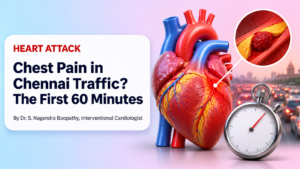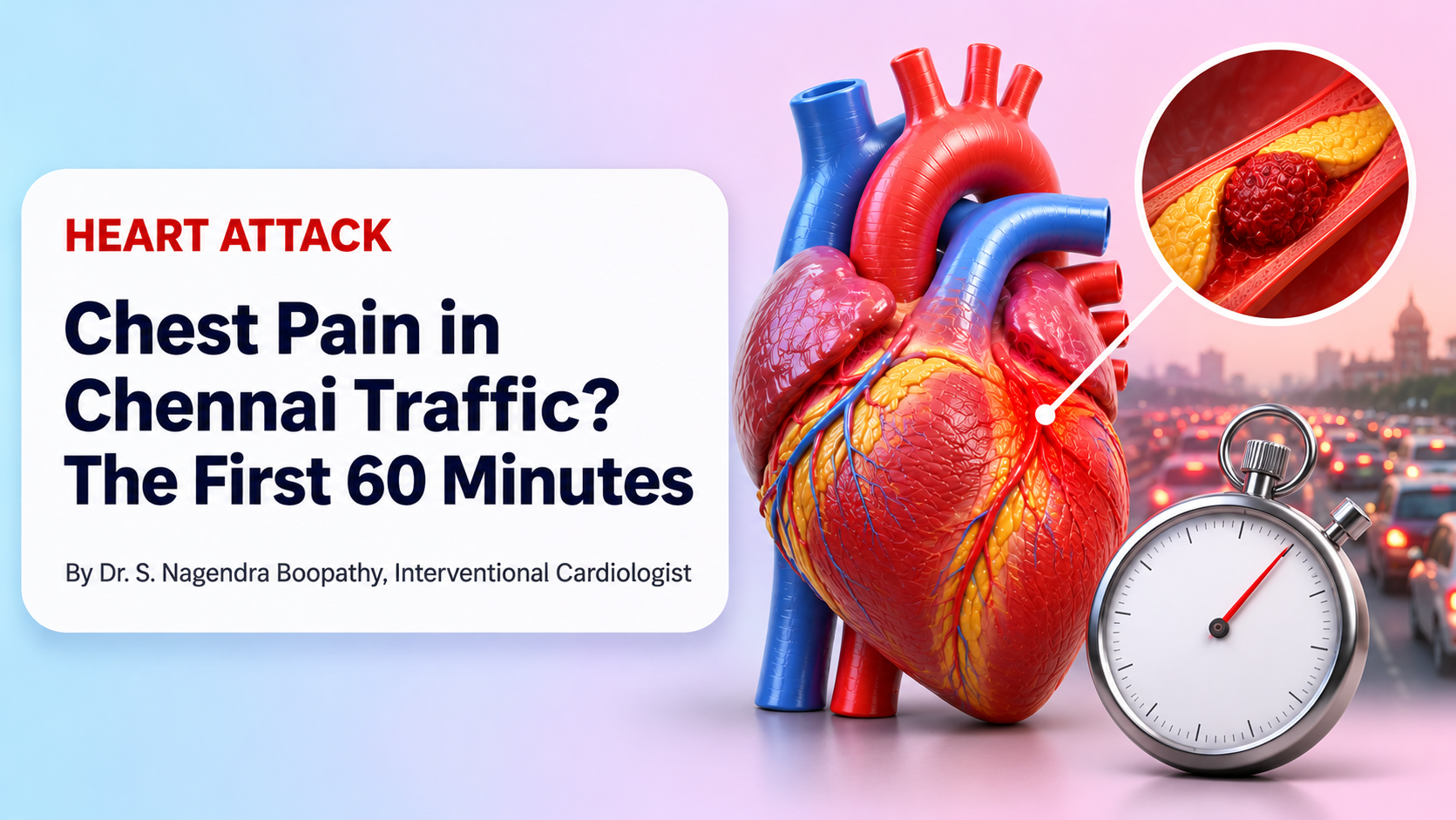
Chest Pain Stuck in Chennai Traffic? The First 60 Minutes That Decide Your Heart’s Future
A minute-by-minute survival plan for a heart attack on the road, from Kathipara to OMR, written by a cardiologist who treats them every week.
6:40 p.m. on a weekday. You are on Poonamallee High Road, or crawling over the Kathipara flyover, or stuck at a signal on OMR. The AC is on, but you start sweating. There is a heavy pressure in the middle of your chest, like someone has placed a brick on it.
Your first thought is usually not “heart attack”. It is:
That decision, made in the first few minutes, is one of the most expensive decisions a person can make. In a heart attack, a coronary artery is usually blocked by a clot. Every minute it stays blocked, more heart muscle dies. Cardiologists have a phrase for this: time is muscle.
Dr. S. Nagendra Boopathy, interventional cardiologist at Sri Ramachandra Medical Center, Chennai, has treated many patients who arrived hours late because they tried to “manage at home” first. This is the plan he wants every Chennai family to know.
First: Know What a Heart Attack Can Feel Like
Women, older adults and people with diabetes may have less typical symptoms, such as breathlessness, unusual tiredness or upper stomach discomfort without much chest pain. If in doubt, treat it as a heart attack.
The 60-Minute Clock
Why Chennai Patients Lose Time
| The delay | What actually happens |
|---|---|
| “Let me first reach home.” | The journey through peak traffic can take 45–90 minutes. That is heart muscle you cannot get back. |
| “Let me ask my family doctor.” | A phone call is fine. Waiting for a clinic to open is not. |
| “I will drive myself, it is faster.” | You may lose consciousness at the wheel, and you have no monitoring if your heart rhythm becomes dangerous. |
| “The ECG at the clinic was normal, so I went home.” | An early ECG can be normal in a heart attack. Persistent symptoms need repeat ECGs and blood tests (troponin) in a hospital. |
| Hospital shopping | Families sometimes move from hospital to hospital comparing options. In a STEMI, the first capable hospital is the right one. |
Call 108 immediately and start hands-only CPR. Push hard and fast in the centre of the chest, about 100–120 compressions a minute, and do not stop until help arrives or the person starts breathing. If an AED (automatic defibrillator) is nearby, at a mall, airport or metro station, use it. It gives voice instructions.
Make Your “Heart Emergency Plan” Today
Dr. Boopathy suggests every family with a heart patient, a diabetic, or anyone above 45 does this once, before an emergency:
- Identify two hospitals with a 24×7 cath lab near your home and your office, so you are not searching during an emergency.
- Save numbers: 108, your cardiologist, and those hospitals’ emergency lines.
- Keep a medical summary on your phone: diagnoses, medicines, allergies, previous stent or bypass details.
- Ask your doctor whether you should carry aspirin, and whether you have any reason not to take it.
- Learn hands-only CPR. It takes less than an hour and can save a life on your street.
- Know your numbers: BP, sugar, cholesterol. Prevention is still the best emergency plan.
Frequently Asked Questions
How do I know whether it is gas or a heart attack?
You often cannot tell at home. Chest discomfort with sweating, breathlessness or spread to the arm, jaw or back should be checked with an ECG in a hospital. It is far better to be reassured in an emergency room than to lose heart muscle at home.
What is the “golden hour” in a heart attack?
It refers to the early period when treatment saves the most heart muscle and lives. Treatment is still worthwhile later, but every minute of delay reduces the benefit.
Should I take aspirin before calling the ambulance?
No. Call for help first. Aspirin is a helpful addition only if it is safe for you, and it should not delay getting to hospital.
Can a young person have a heart attack while driving?
Yes. Heart attacks in people in their 30s and 40s are increasingly seen in India, especially with smoking, diabetes, high cholesterol and strong family history. Age alone should not make you dismiss chest pain.
Where can I get emergency angioplasty in Chennai?
Many major Chennai hospitals provide 24×7 primary angioplasty. Dr. S. Nagendra Boopathy is an interventional cardiologist at Sri Ramachandra Medical Center, Porur, Chennai. Identify your nearest capable centre in advance.
Do Not Wait for the Emergency to Plan for It
If you have risk factors or have had chest discomfort that “settled on its own”, get evaluated now. A planned consultation is always easier than an emergency one.
Dr. S. Nagendra Boopathy · Interventional Cardiologist · Sri Ramachandra Medical Center, Porur, Chennai
Medical disclaimer: This article is general information and not a substitute for emergency care. If you think you or someone else is having a heart attack, call 108 or go to the nearest hospital emergency department immediately.
References: 2023 ESC Guidelines for the management of acute coronary syndromes; 2025 ACC/AHA/ACEP/NAEMSP/SCAI Guideline for the Management of Acute Coronary Syndromes; American Heart Association 2025 Guidelines for CPR and Emergency Cardiovascular Care; Mayo Clinic, Heart attack: First aid.